The maps of the future are drawn on napkins: the art of anticipating rather than copying
Next practices as a compass, not as a trend. When change moves faster than the manuals, following “best practices” can sound reasonable… until it becomes irrelevant.

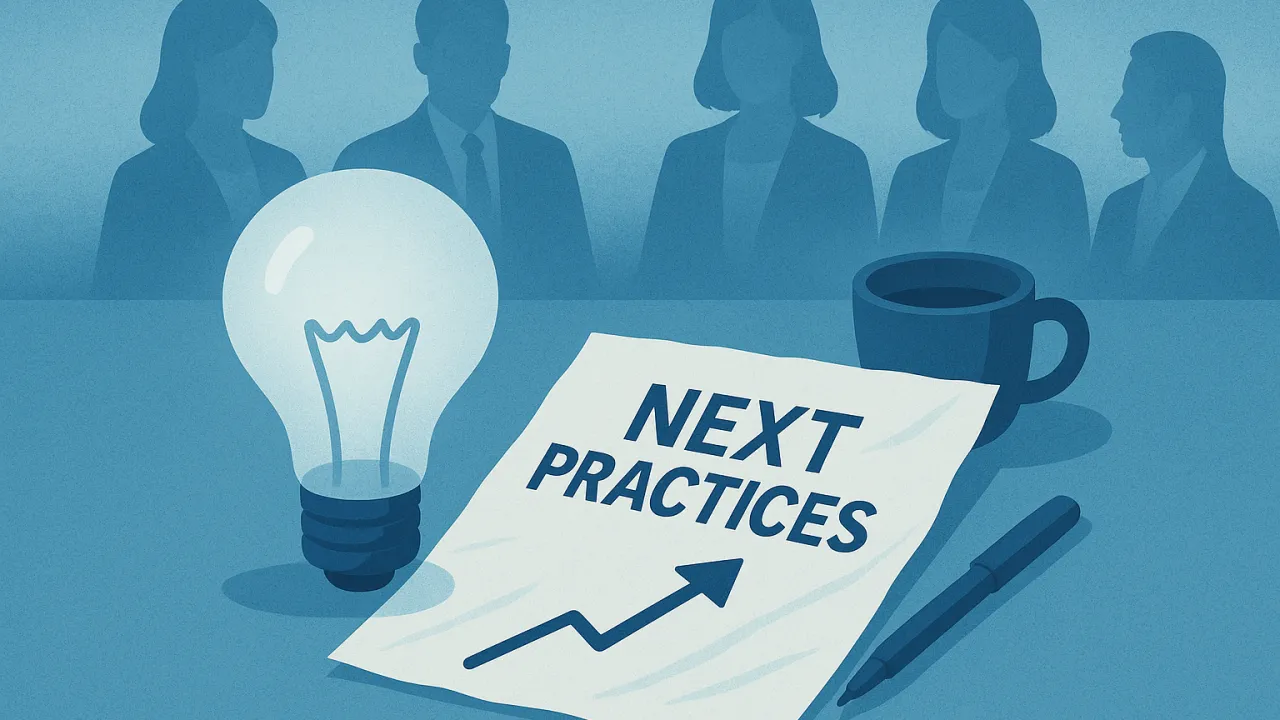
Next practices as a compass, not as a trend.
When change moves faster than the manuals, following “best practices” can sound reasonable… until it becomes irrelevant. Because when everyone is doing the same thing, “best” loses its differentiating value and becomes a saturated path.
The obsession with best practices is understandable and even necessary to some extent. They are safe, proven, and come with the endorsement of having worked in another context. The problem is that context no longer exists. The economy, technology, and society are being reshaped in real time. What was a brilliant solution yesterday can become an anchor today.
I remember when I worked as part of the leadership team at the Corporate Executive Board ( CEB, now Gartner ) , a Washington D.C.-based think tank focused on strategic intelligence and research to identify, analyze, study, and share global management best practices. We had a series of companies that were constant producers of best practices, and indeed, many of them shared them so we could analyze and distribute them. One day a client asked me how it was possible for companies to share their best practices. I explained that there were many reasons and motivations, obviously, and it depended a lot on each case.
But I decided to give him the answer he least expected: “Many companies share their best practices because they are in the game of next practices; they are always ahead while simultaneously setting the course for others with their present, not future, by sharing their best practice.”
The leaders who are shaping the future don’t just do so on digital whiteboards; they do it on napkins, in cafes, in conversations full of doubts rather than certainties, often waking up and quickly jotting down that disruptive or even “outlandish” idea they just woke up with, scribbled in a notebook on their bedside table. They’re the ones who don’t wait for a trend to appear so they can follow it; they sense it before it even has a name. And instead of seeking validation, they look for weak signals, emerging patterns, and questions that are still uncomfortable.
While many keep investing in efficiency, visionaries invest in strategic imagination. While some perfect the present, others experiment with the future.
In an environment where the only constant is disruption, next practices aren’t a trend. They’re a compass.
Anticipation isn’t just about prediction, but about preparation, building the capacity to respond to the unexpected, assuming that mistakes are part of the experiment. Next practices aren’t promises of success. They’re informed attempts to explore what doesn’t yet exist. And they require an uncommon dose of courage: to let go of the known even when there are no guarantees about the new.
That’s why many of these practices are born on the margins; in small teams, in prototypes ignored by bureaucracy, in ideas that seem crazy until they change entire industries. These are the ideas that don’t fit in Excel, but fit on a napkin.
True innovation doesn’t come from copying what works, but from creating what hasn’t been tried yet.
But let’s not kid ourselves: leading with a next-practices mindset doesn’t mean improvisation. It’s about cultivating design thinking, reading the context, and mobilizing others toward uncertainty. It involves a discipline that goes beyond planning and enters the realm of curiosity and strategic exploration—accustoming your leadership team to adopt a corporate and business philosophy of risk-thinking, not just risk-taking.
Are we managing change… or just updating old recipes with a more modern presentation?
Those who anticipate aren’t magicians. They are restless readers of the present who dare to imagine what doesn’t yet have a shape.
The napkin is just a symbol of the informal, the spontaneous, the still “draft” stage. But it’s also the place where great ideas are born. Where maps of the future are drawn that later end up changing the course of companies, industries, and countries.
Because in times of radical uncertainty, the greatest boldness lies not in applying what’s proven but in betting on what’s possible.
Best practices invite us to repeat. Next practices challenge us to imagine. Don’t let someone else control your strategic compass or visionary north. Create it yourself if you truly want to be the one who changes the rules of the game in your market.
As always, I’ll leave you with some uncomfortable, but necessary, questions:
Does your team simply monitor your industry’s best practices, or do they also look at and analyze those from very different industries? Do you make imagination, even thinking about potentially super-disruptive or absurd ideas, a regular tool in your team’s brainstorming processes?
If you enjoy strategic thinking without the rigidity of corporate manuals, if you believe leadership needs more agility and fewer coffee-mug clichés, if you’re tired of shallow reflections and enjoy a well-placed, unexpected analogy… then I’ll see you here next week.