The False Dilemma Between Ethics and Strategy: Realism or Corporate Cynicism?
When making tough decisions doesn’t mean abandoning your principles. Some insist that “you can’t have it all”: you’re either strategic or ethical.

When making tough decisions doesn’t mean abandoning your principles.
Some insist that “you can’t have it all”: you’re either strategic or ethical. But that supposed either-or says more about our excuses than about reality. In corporate environments, where high-impact decisions are made under pressure, neither ethics nor principles should become collateral damage. The key is to dismantle the false premise that what’s right and what’s effective are mutually exclusive, and to propose a more mature, and admittedly more uncomfortable, way of leading with conscience without sacrificing effectiveness.
In other words, we need to evolve toward a mindset of crafting decisions rather than merely taking them. That’s precisely why I love the English term “decision making” more than the Spanish “tomar decisiones.” Strategic decisions must be crafted, not just taken, and in that very distinction lies their power. If we “make” our decisions, we can prove time and again that conscience and effectiveness need not be at odds in the business world.
When the dilemma between what’s right and what’s convenient is presented, the greatest danger isn’t choosing wrongly…it’s convincing yourself there is no choice.
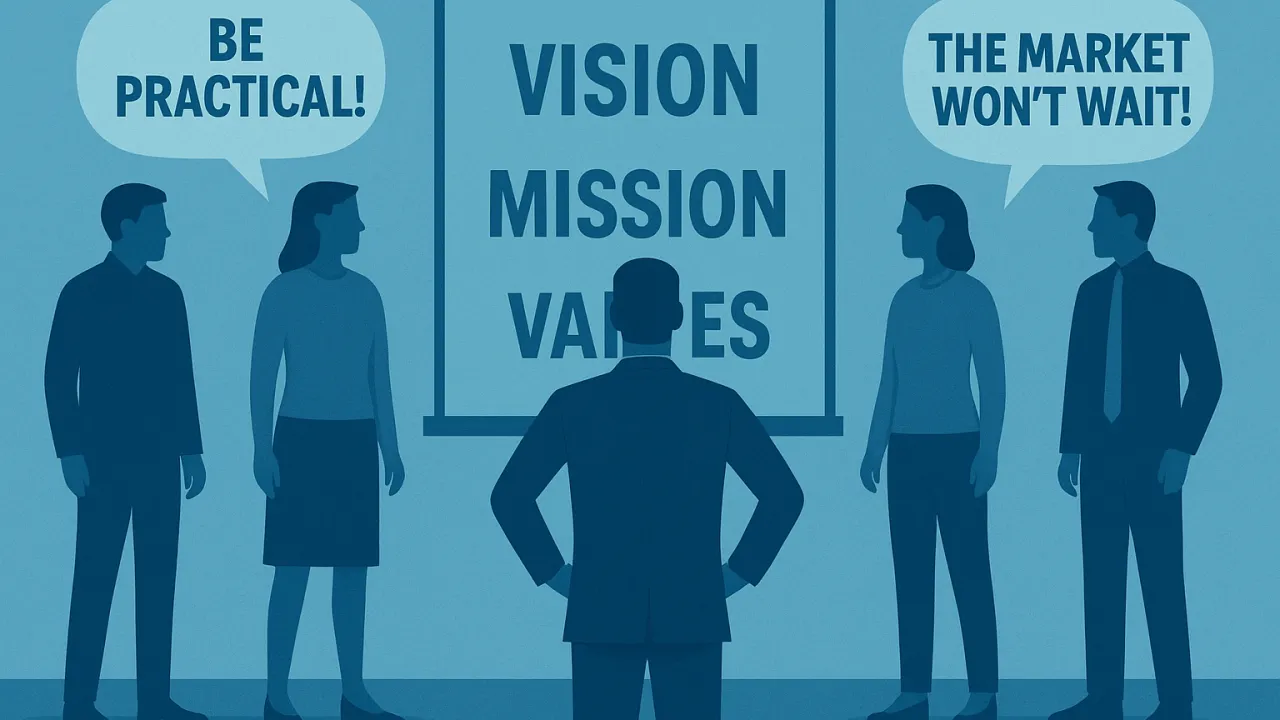
In many governing bodies, strategic conversations are tinged with resignation: “we have to be practical,” “the market won’t wait,” “our competitors are already doing it.” Beneath these phrases hides a dangerous rationalization of cynicism. Ethics is portrayed as a luxury, something only affordable when everything is going well. But that logic is exactly what allows short-term gains that ultimately erode legitimacy and reputation over the long haul.
Worse still, the real peril in these governing bodies is that a short-term decision, often violating not only core principles but even the organization’s own strategic framework (vision, mission, and values), gradually becomes the new course. In the corporate world, sinning is permitted as long as it’s a conscious “venial” sin, that is, one that doesn’t breach ethical principles.
The secret of a short-term “venial” sin in business is to commit it consciously, not unconsciously, because if you sin even venially without realizing it, it will become your new North Star and will fatally undermine your long-term strategy.
The problem isn’t recognizing dilemmas. The problem is using dilemmas as an excuse to give up.
Business history is full of leaders who faced complex moments without sacrificing their principles. Not because they were naïve idealists, but because they understood that trust is a strategic asset. They told the truth when it would have been easier to spin it. They owned up to mistakes before the market exposed them. They refused to do what everyone else was doing just because “it works.”
Consistency, in times of uncertainty, is not a moral luxury. It is an underestimated competitive advantage.
This isn’t about romanticizing ethics, it’s about integrating it intelligently. Being ethical doesn’t mean being slow, weak, or politically correct. It means thinking beyond the financial quarter and the immediate applause. It means designing business models where sustainability isn’t limited to the environment but extends to human dignity and institutional strength.
And yet many still confuse integrity with naiveté. They mock “do-gooders,” yet applaud short-termism or principled‐free tacticism as if it were courage.
Perhaps the real act of strategic courage isn’t making tough decisions, but making them without betraying yourself.
I remember a critical moment in my corporate life, two days after the September 11, 2001 attacks on the Twin Towers. Our CEO had called an all-hands meeting: we were a strategy research and consulting firm based in Washington, D.C., so the terrorist attacks hit very close to home. Both the executive team and our consultants typically traveled over 50% of each year for client meetings, and of course, everyone felt nervous, stressed, even afraid to board a plane.
The CEO’s message was crystal-clear: “We’re all in shock. We each know someone, directly or indirectly, who was a victim or affected by these attacks. Please reschedule your travel plans until you feel comfortable; in the meantime, serve our clients by phone and email, and do whatever extra we can to help them. But above all, your priority as members of this society must be to care for yourselves, your families and loved ones, and our community in this collective mourning.” We all exchanged glances, felt a genuine sense of relief, and saw real coherence in leadership and strategy.
Can a company grow without resorting to dubious shortcuts? Can you negotiate hard without crossing the line? Is it possible to innovate without masking risks as opportunities? What damage does a leader’s brand suffer when they rely on shortcuts and short-termism? The answer lies not at the extremes, but in the ability to hold uncomfortable conversations within the organization, conversations that don’t oversimplify dilemmas, but don’t disguise them either.
This isn’t a call for perfection. It is a call not to resign ourselves to cynicism as the norm.
Because if the future demands more lucid leaders, it also demands braver ones. Not those who raise ethical banners for the photo op, but those who uphold principles when no one is watching.
And you—do you lead to justify yourself or to transform? Are your decisions strategic, filtered through your own strategic framework, or are they just convenient?
If you enjoy strategic thinking without the rigidity of corporate manuals, if you believe leadership needs more agility and fewer coffee-mug clichés, if you’re tired of shallow reflections and enjoy a well-placed, unexpected analogy… then I’ll see you here next week.