The Last Crusader: Charlie Kirk and the moral duty of a mature democracy
His legacy: fearless dissent, listening without hate I was going to open the new season of my newsletter When Leadership Meets Strategy with a different topic. But the tragedy of September 10th in Utah changed the script.
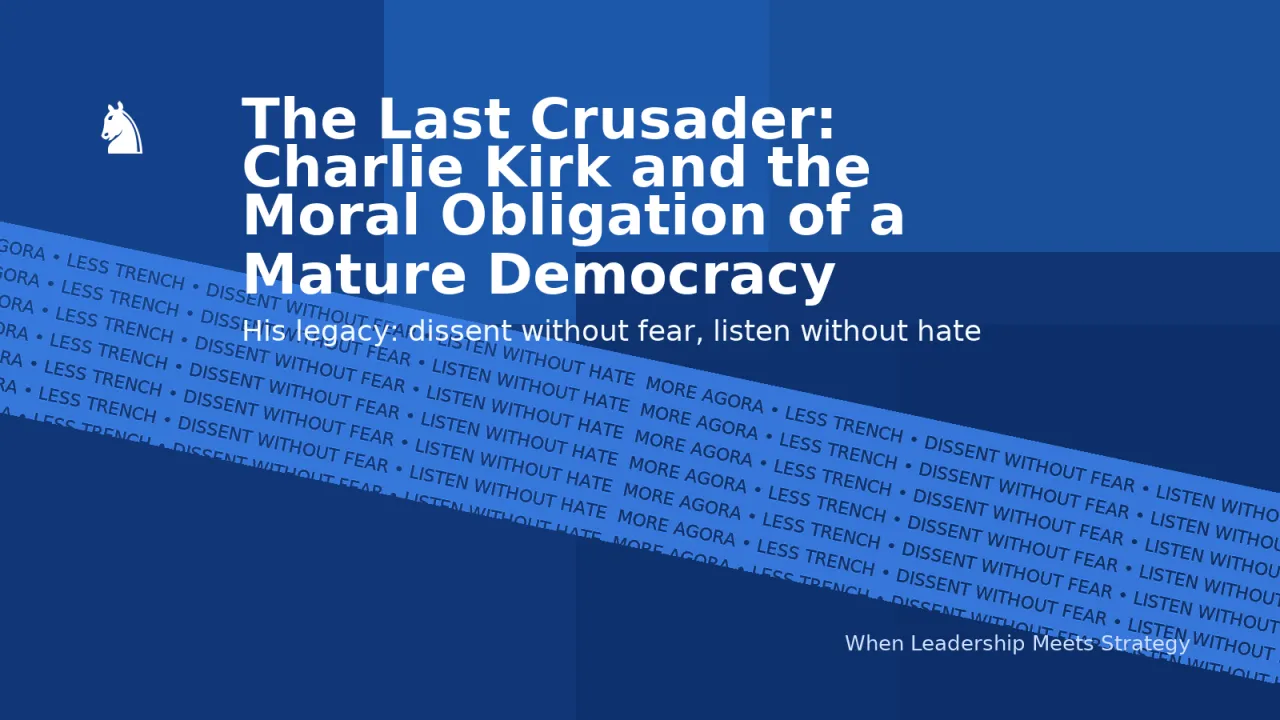
His legacy: fearless dissent, listening without hate
I was going to open the new season of my newsletter When Leadership Meets Strategy with a different topic. But the tragedy of September 10th in Utah changed the script. I felt obliged to defend the civic legacy that Charlie Kirk embodied, the capacity to disagree without violence, while at the same time acknowledging my civic co-responsibility to denounce the incoherence that erodes our public life and our societies, and all those who, by segmenting opinions and emotions, manage to divide us and draw out the worst in us until something terrible happens, as it did to Charlie yesterday.
Two days ago, September 10th, the activist and founder of Turning Point USA, Charlie Kirk (31 years old), was murdered by a sniper while speaking at Utah Valley University. Authorities recovered a bolt-action rifle; the shooter remains at large as the investigation continues with federal support. The university has closed the campus until Monday to care for its community.
Out of a sense of civic responsibility I have decided to write about this because, when a speaker is murdered on a campus, it does not only extinguish a voice: it steals history.
Charlie Kirk was a “last crusader,” and I am not speaking of swords or daggers, but of the power of the word. I am speaking of a young man stubborn about a civilisational principle: “in a mature democracy, disagreement does not require demonisation”. Charlie would go, fully aware of the safety and personal risk, into hostile forums to invite argument. His method (“come, refute me, but do not cancel me”) is the essence of a healthy public square: not to convince everyone, but to train the civic muscle that allows one to lose without breaking. The bullet that silenced his voice sought to decree that force decides when reason fails. And that is precisely the decree that an adult society cannot accept.
If today you justify the silencing of the one you detest, tomorrow you’ll endorse the silencing of the one you love.
For many young people, his presence had a pedagogical usefulness rare in the age of hashtags: defending a thesis before those who do not want to hear it. Whether one agrees with his ideas is secondary to what matters: to show that the agora exists and that one learns by “sweating ideas”, not by lobbing them from the stands. That is why his assassination steals possible futures: debates that will no longer happen, conversions we will no longer witness, corrections that will never be written.
The university campus is, by design, the place where one can present, listen and reply without physical fear. If we turn its perimeter into a cordon of panic, or into a perimeter that only welcomes what pleases, we will have degraded the institution to the ground zero of its mission. Safeguarding the right to dissent is the opposite of armouring the campus to the point of making it impassable: it means designing rules, protocols and culture that place argument at the centre and keep aggression out of play. (UVU has closed temporarily; may that silence serve to recalibrate without capitulating.)
Allow me an irony: some sectors of the progressive press, so committed to “lowering the tone” and “humanising the adversary”, allowed themselves, in the midst of necrological coverage, interpretations that verge on the “yes, but…”. The MSNBC/Dowd case is illustrative: remarks that insinuated improper moral causalities in the heat of the moment, a belated correction and a summary dismissal. I do not cite it to settle scores, but to underscore corrosive incoherence: if you demand ethical standards of the other side, apply them to yourself first when it is hardest.
Coherence isn’t a rhetorical luxury; it’s the only cement of a mature democracy.
Political assassination not only kills the individual: it expropriates other people’s biographies. It takes with it minds not yet convinced who, over the years, might have crossed bridges; schools that would have invited debate; adversaries who might have come to respect one another. That is the intangible cost societies rarely compute: the loss of counterfactual trajectories. When you kill the one who debates, the alternatives grow poorer.
Those of you who have read me before know how I tend to draw lessons from the political sphere to the corporate one and vice versa. That is why, in companies too, the serious ones, disagreement is an asset; the Board institutionalises it in committees, voting rules and challenge sessions. The opposite is called an “echo chamber” and usually ends in existential risk. A mature democracy works the same way: either we turn dissent into a method, procedures, guarantees, rites, or we open the door to the law of the strongest.
Organisations that confuse alignment with homogeneity end up poor in ideas and rich in scares. Countries too, therefore, their societies.
Three reflections necessary after a tragedy like this
1. Debate, yes; demonisation, no. The language that dehumanises the adversary is petrol for the lone fanatic. Neither vehemence nor moral certainty justifies the leap to violence.
2. Freedom of expression with realistic security. Universities and organisers must shield the right to dissent with discreet and effective protocols, preventive intelligence, and zero tolerance of aggression, whoever it comes from.
3. Cross-cutting coherence. Either we repudiate political violence always, or we open the door to justifying it when “it suits us.” There is no mature democracy with double standards.
Charlie, I followed you and admired your ability to argue and persuade without reciprocating the insults and labels you constantly received. I did not always share all your conclusions, but I did share your courage in showing up on those campuses full of young people who are victims of political and media demagogy. When so many preferred to silence, you chose to argue. Today you leave us an uncomfortable and beautiful task: not to retreat a millimetre from the right to dissent without fear. May your wife, your children and your friends find comfort in knowing that your battle was for the word and that, if it is up to us, it will continue to be fought with voices raised and hands open. Rest in peace, last crusader.
If you enjoy strategic thinking without the rigidity of corporate manuals, if you believe leadership needs more agility and fewer coffee-mug clichés, if you’re tired of shallow reflections and enjoy a well-placed, unexpected analogy… then I’ll see you here next week.