The Strategic Horizon · Who trusts Europe? Why reliability now outweighs size in the West’s alliances.
Brussels has just offered an ally a status its treaties do not recognise and its own member states declined to sign. In a West that no longer revolves around Washington, the currency of alliances is no longer size but the capacity to deliver when delivering is costly.

Brussels has just offered an ally a status its treaties do not recognise and its own member states declined to sign. In a West that no longer revolves around Washington, the currency of alliances is no longer size but the capacity to deliver when delivering is costly.
Few things reveal more about a negotiation than the moment the parties start arguing over what to call the deal rather than what is in it. This week in Montreal, the European Union and Canada staged one of those moments.
In her State of the Union address, Ursula von der Leyen proposed making Canada the European Union’s first “associate member”. The formula had ambition and one small drawback: it does not exist in the treaties. Several member states worried it would be confused with ordinary association agreements, and the opposition was led by Germany, the same country that had once floated the label for Ukraine. After weeks of negotiation, the phrase was dropped from the joint statement. Chancellor Merz preferred to speak of an “Alliance for the Future”. The Commission President carried on using her formula in public. From the other side of the table, Mark Carney summed the matter up in a sentence any board member will recognise: “The name doesn’t matter.”
It would be easy to file the episode under Brussels protocol. I think it is more revealing than that: a fairly precise picture of Europe’s strategic problem at this moment.
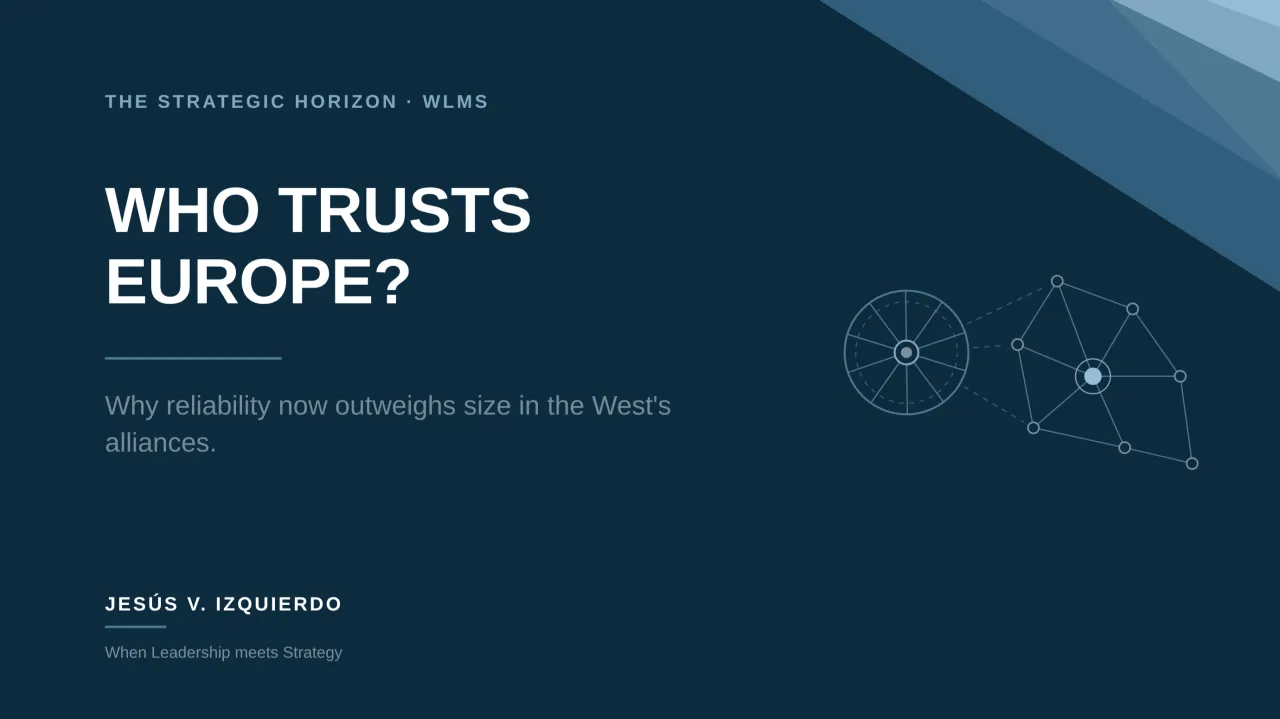
To see why, one has to look at the shift underneath. For three quarters of a century, the West worked like a wheel: many spokes and a single hub, Washington. Security, the reserve currency and much of the rulebook for trade ran through that centre. Allies barely needed dense relationships with one another; it was enough for each to keep on good terms with the hub. That hub is now considerably less predictable. That the President of the United States has gone so far as to suggest that a rapprochement between two of his oldest allies is a “hostile act” captures the moment better than most briefing papers. What was on display in Montreal, and is visible in other capitals, is the spokes trying to connect with each other. The West is moving from a wheel to a network.
And in a network, the currency changes. In the wheel, an ally’s value depended on its weight and its proximity to the centre. In the network it depends on something simpler and far harder to manufacture: whether it honours what it signs when honouring it becomes expensive. Reliability becomes the new scale. A mid-sized, predictable partner is worth more than a large one whose word shifts with every electoral cycle. In the wheel, loyalty to the centre was enough. In the network, every node has to earn its place, and every other node is watching.
Europe knows this lesson well, though it learned it the expensive way. Its energy policy over the past two decades was, in essence, a wager on price over reliability. Russian gas was cheap, and for years it was taken for granted that commercial interdependence would eventually tame the supplier. After 2022, Europe diversified its suppliers with remarkable speed. What it did not diversify was its criterion. Its largest supplier of liquefied natural gas is now the United States, precisely the partner whose predictability is in question, and another share of its supply depends on cargoes passing through the Strait of Hormuz. QatarEnergy declared force majeure in March and has renewed it month after month; Italy’s Edison alone has lost 29 cargoes since April. On 20 October, European gas touched €90 per megawatt hour, its highest level in almost four years, with EU storage at 74% against 83% a year earlier. Germany’s stood at 61%.
The lesson is not about Russia or Qatar. It is about the selection criterion. Reliability has a cost, in redundancy, dearer contracts, storage or capacity of one’s own, and for years Europe preferred not to pay it. Buying cheaply from an unreliable supplier is not saving money. It is deferring payment, usually at a worse rate of interest. Readers of Tuesday’s Leadership Table will recognise the logic: candour cannot be requested, it has to be paid for. Neither can reliability.
This is where it becomes uncomfortable. Europe has spent several years asking, quite rightly, whom it can trust. Montreal suggests the question also travels in the other direction. When Ottawa, Tokyo or Seoul assess Europe as a partner, they ask what any board asks of a counterparty: who signs, under what mandate, and whether that signature will survive the next election. An institution that announces a legal category that does not exist, only to see its own shareholders withdraw it weeks later, does not exactly radiate predictability. The offer was generous. It simply lacked backing.
The objection deserves to be taken seriously, because it is a strong one. The Union is not a state. It is an association of twenty seven sovereign democracies, and expecting it to behave with the coherence of a national government is a category error. Seen that way, the Commission’s ambiguity was exploratory diplomacy: floating an idea to test the reaction before committing. And the slowness of the Twenty-Seven, so often mocked, is precisely what makes their commitments durable once they arrive. An agreement that has survived twenty-seven potential vetoes is unlikely to be undone by a change of government.
The argument is sound and, curiously, it strengthens the thesis rather than dismantling it. If European slowness is a source of reliability, then the problem in Montreal was not Germany. It was the announcement. Berlin, in refusing to sign something nobody could define, was the reliable partner in the room. Reliability depends less on the speed at which decisions are made than on the distance between what is announced and what can be delivered. Slow institutions can be extraordinarily reliable. Those that promise beyond their mandate rarely are.
What will ultimately count from Montreal is the substance capable of backing the label: digital trade, technological cooperation and a study of gas supply from across the Atlantic. That one of those pieces should be energy from a stable partner hardly looks like a coincidence.
For anyone sitting on a board, the episode carries two implications. The first concerns the choice of partners. For thirty years, supply chains, the choice of jurisdiction or the entry of an investor were judged chiefly on price, return and size. The question that ought to govern those decisions today is simpler and a good deal more demanding: who will deliver when delivering costs them? Answering it means studying track records under pressure, not sales presentations. How that supplier behaved in 2020, that partner in 2022, that jurisdiction in its last crisis. A board unable to answer it for its five critical counterparties is carrying a risk that does not yet appear in its risk register. Reliability does not show up in the purchase price. It shows up on the invoice the day it fails.
The second implication looks inward. In an economy organised as a network, companies are also assessed as counterparties. Many firms, including a good number of distinguished family enterprises, live with a considerable gap between what their chairman announces at a conference and what their organisation is able to execute. That gap, long forgiven as enthusiasm, has started to carry a price. Whoever closes it gains something more valuable than a cost advantage: they become the partner others call first.
Europe leaves Montreal with an alliance under construction and a label still awaiting definition. For decades it could afford to be large without being especially predictable, because someone else guaranteed the order. That margin has narrowed, for states and for companies alike. The question every board should be asking this week comes in two halves, and the second is the uncomfortable one: how many of your partners could you trust if delivering became expensive for them, and how many of them would say the same of you?
If you enjoy strategic thinking without the rigidity of corporate manuals, if you believe leadership needs more agility and fewer coffee-mug clichés, if you’re tired of shallow reflections and enjoy a well-placed, unexpected analogy… then I’ll see you here next week.