The Strategic Horizon · What family enterprises teach us about Europe’s strategic drift.
The third-generation syndrome explains, better than any policy report, why a rich and free continent is squandering its founders’ inheritance, and why its greatest threat lies not with its adversaries but in its own boardroom. Shirtsleeves to shirtsleeves in three generations.
The third-generation syndrome explains, better than any policy report, why a rich and free continent is squandering its founders’ inheritance, and why its greatest threat lies not with its adversaries but in its own boardroom.
Shirtsleeves to shirtsleeves in three generations. The Spanish version of this saying involves a wine merchant, a gentleman and a beggar, but the plot is the same. Anyone who has spent enough years in family enterprise boardrooms knows the saying and, more to the point, knows the scene that precedes it. The third generation inherits a company with a sound balance sheet, a respected name and a reputation that still opens doors. What it does not inherit, because it cannot be inherited, is the reason the grandfather was willing to go broke twice before getting it right. The assets arrive intact. The purpose arrives as an after-dinner anecdote.
I have sat through that meeting many times. No one in the room is incompetent or ill-intentioned. Each has simply learned to enjoy accumulated capital without ever having had to defend it, and has come to mistake abundance for strength. The board agenda fills with urgent matters and empties of fundamental questions.
Over the past two days, the European Union’s heads of state and government have met in Brussels. The invitation letter from the President of the European Council set out the agenda: temporary measures against high energy prices, the competitiveness of European industry, critical gaps in military capability, the response to Russia’s hybrid attacks, the instrumentalisation of migration. Read through the eyes of a family enterprise advisor, this is not the agenda of a power. It is the minutes of a third generation discovering, all at once, the cost of everything it stopped paying for.
It is worth recalling who the founders were. Robert Schuman, Konrad Adenauer and Alcide De Gasperi did not build the European Community on a spreadsheet. They built it on the ruins of a continent that had just discovered what it was capable of, and they did so with a precise conviction: the dignity of the person precedes the state, economic freedom is inseparable from responsibility, and peace between nations may rest on shared interests but endures only if a common moral foundation lies beneath them. Those men knew why they were doing what they did. They had learned it at the highest price imaginable.
The second generation did what good second generations do. It professionalised, expanded the market and multiplied the patrimony. The single market, the euro and enlargement to the East were extraordinary feats of management.
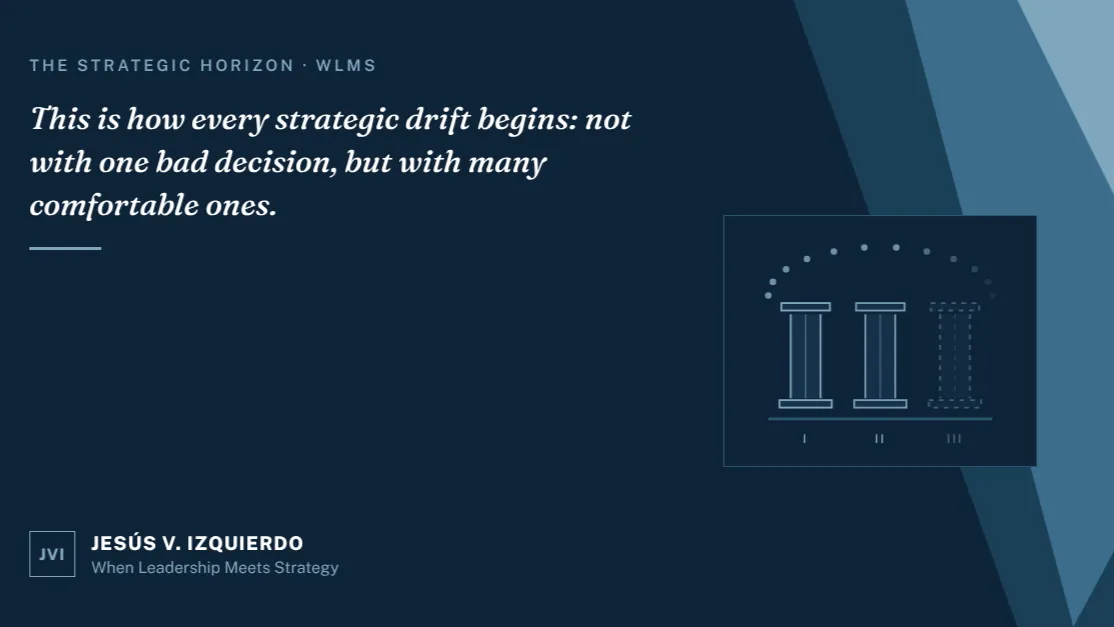
The third generation did something more comfortable. It delegated. It entrusted its security to Washington for three decades without asking what would happen the day Washington had other priorities. It built its industrial model on cheap Russian energy and treated dependence as though it were diplomacy. It tied much of its export growth to China and called strategy what was, at best, a wager. In 2024, Mario Draghi, not a man given to rhetoric, described Europe’s competitiveness challenge as existential. The word was filed away with the report. This is how every strategic drift begins: not with one bad decision, but with many comfortable ones.
The opposing argument deserves to be taken seriously, because it is a strong one. Europe remains one of the richest, freest and safest places on earth. Its rule of law, its life expectancy and its institutional quality are still the envy of much of the world, including most of Latin America. The prophets of its decline have been wrong for more than a century, at least since Spengler published the first volume of The Decline of the West in 1918. And when Russia invaded Ukraine, Europe responded with more unity and more speed than almost anyone expected.
All of this is true. But anyone who has accompanied the decline of a family enterprise knows that the income statement is the last indicator to speak, not the first. Business families are not ruined on the day they lose their money. They are ruined years earlier, on the day no one at the table is prepared to pay a personal cost to defend what the founder held to be non-negotiable. The balance sheet is always the last to find out.
It is into that vacuum that activist shareholders arrive.
In capital markets, an activist does not create a company’s weakness. It detects it. It looks for firms with valuable assets, passive boards and a management that has stopped defending its own investment thesis. It comes in with a small stake, a clear narrative and a resolve the board lost some time ago. It almost always gains more ground than its stake would justify, precisely because what it faces across the table is not conviction but administration.
Europe today has two particularly effective activists, and they should be named with precision, because imprecision is a gift to both.
The first is political Islamism, which must not be confused with Islam, nor with the millions of Muslims who live in Europe as citizens loyal to its institutions. I mean a specific political project, one that seeks to subordinate civil law to religious norm and uses the freedoms of the liberal order to erode its foundations. Its advantage is not numbers. It is that it knows exactly what it wants, facing societies that have forgotten.
The second is the radical left, the strand that regards the Western inheritance as a debt to be atoned for rather than an estate to be stewarded. Its advantage is similar: it offers moral certainty to a generation that no one ever told why the institutions it inherits are worth defending.
On almost everything else, the two projects are incompatible. They agree on the one thing that matters to them: the diagnosis that the board will not defend the charter.
Here lies the uncomfortable part of the argument, and the part that interests me. Europe’s principal threat is not its activists. It is its board. No activist has ever taken control of a company whose board knew why it existed and was willing to bear the cost of saying so.
Europe’s board, and I do not mean the one that met in Brussels this week, tends to fail in one of two ways. The first is polite capitulation: ceding ground in the name of tolerance until it discovers that tolerance without a charter is not a virtue but a vacancy. The second is more recent and no less dangerous: handing the defence of the purpose to whoever promises to save the company by burning down half the family. Every family enterprise advisor has seen that branch which, faced with decline, proposes remedies so drastic that they end up destroying precisely what they claimed to protect. The answer to an activist has never been another activist. It has always been a board that recovers its function.
What does a good board do with a third generation that has lost its bearings? I have seen it work only a few times, and always in the same way. First, it stops confusing preservation with refoundation. Preserving is managing inertia. Refounding is restating, in today’s language, why the enterprise deserves to go on existing, and accepting that the answer will carry costs. Second, it writes a family constitution. The families that survive the third generation are the ones that have put in writing what is negotiable and what is not, and made clear what happens when someone crosses that line. A family constitution is not an act of exclusion. It is the condition for belonging to mean something.
Europe needs something very similar. Not a new treaty, nor another package of temporary measures, but the clarity to state what is non-negotiable in the European project, beginning with the dignity of the person and equality before the law, and the willingness to sustain it with its own means: its own energy, its own defence capability, its own growth. Temporary measures are what a board resorts to when it has not yet decided what it is.
For those reading from inside a family enterprise, in Europe or across the Atlantic, there is a second layer here. Europe is today the most visible case study of the third-generation syndrome, but not the only one. The pattern repeats itself in hundreds of companies with sound balance sheets and forgotten purposes, and it is almost never recognised from the inside.
In family enterprises, the decisive moment never coincides with the crisis. It comes earlier, in an apparently routine meeting, when someone asks why we exist and a silence falls that no one dares to break. Europe holds that meeting every few months in Brussels. Who on your board would break that silence, and what would they be willing to lose by doing so?
If you enjoy strategic thinking without the rigidity of corporate manuals, if you believe leadership needs more agility and fewer coffee-mug clichés, if you’re tired of shallow reflections and enjoy a well-placed, unexpected analogy… then I’ll see you here next week.