The Leadership Table · What no board would tolerate from Pedro Sánchez, President of Spain.
A mandate is not ownership: winning an election confers the right to govern, not the right to disable the checks that constrain those who govern. No serious board would accept the following from a chief executive.
A mandate is not ownership: winning an election confers the right to govern, not the right to disable the checks that constrain those who govern.
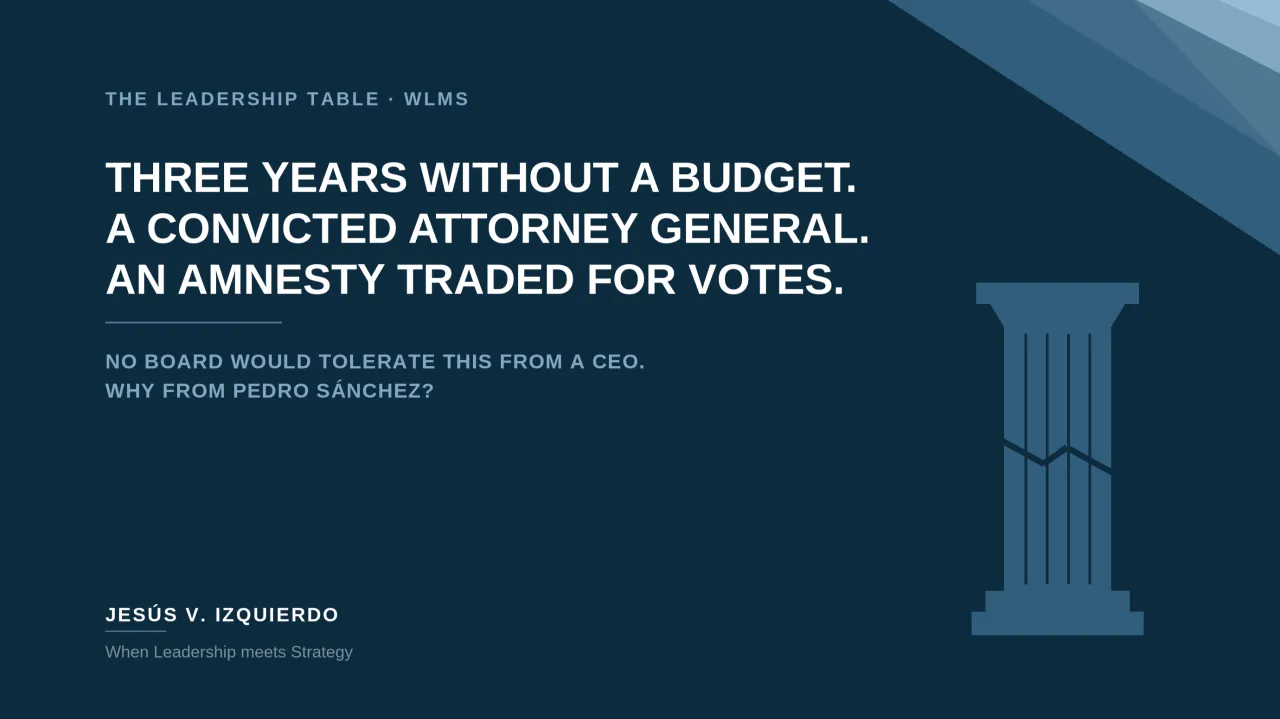
No serious board would accept the following from a chief executive. Three consecutive years without an approved budget, defended on the grounds that the one from three years ago still suits the company rather well. A head of compliance convicted by the body responsible for judging him, followed by a statement from the top that management still believes in his innocence. And a rule declared non-negotiable before the shareholder vote that becomes negotiable the week after, at precisely the moment management needs the votes of those who broke it.
None of this happened in a company. It happened in Spain.
Pedro Sánchez, Spain’s Prime Minister, has called a general election for 29 November. I write from no party, but with a conviction I would rather declare at the outset: I believe his mandate should not be renewed. My principal objection is not economic, though I disagree with much of his economic policy. It is an objection about leadership and governance, which is why it belongs in this column.
Medieval jurists distinguished two ways of losing authority. Bartolus of Sassoferrato, and later Francisco Suárez, separated the ruler who lacks lawful title from the ruler who holds it and exercises it unlawfully. One need not come anywhere near tyranny for the distinction to be useful. It reminds us of something every director knows: a mandate is won at the ballot box, but legitimacy is lost in the exercise.
Sánchez has legitimacy of origin, and it should be said plainly. He was invested under the Constitution by a parliamentary majority. Disliking a coalition does not make it illegitimate. The problem lies in the exercise, and it becomes visible when one examines the checks one at a time.
Before the July 2023 election, Sánchez and his ministers maintained that an amnesty for those involved in the 2017 Catalan secession attempt had no place in the Constitution. After the election, it became the price of his investiture. Emiliano García-Page, a senior figure in his own party, put it with more precision than I could allow myself: what did not fit in the Constitution suddenly did, from one day to the next. The Constitutional Court later upheld the law by six votes to four, which settles its legal validity. It does not settle the other question. In any boardroom we would call it what it is: changing the criteria after the vote, in exchange for the votes.
The budget tells a similar story. The Constitution requires the government to present one each year, and this parliament has not passed a single one. Spain is running 2026 on the 2023 accounts, rolled over for the third time. A budget is not an accounting formality. It is the instrument through which a parliament, like a board, governs those who govern. An executive that learns to live without one has learned to live without answering for the only thing that ultimately matters: how other people's money is spent.
In November 2025, the Supreme Court convicted Spain's Attorney General of disclosing confidential information. The Prime Minister responded that he still believed in his innocence. There were dissenting opinions, the ruling is under appeal, and anyone may disagree with a verdict. But the independence of a control system is not measured on the days it agrees with management. It is measured on the days it does not, and by how management behaves on those days.
Ceuta adds a variation on the same problem. In late July, tens of thousands of people entered Spain's North African city irregularly in barely two days. It later emerged that risk assessments and intelligence about a possible mass crossing had circulated the week before. The government maintains that none of them made it possible to foresee the scale, and the National Court is investigating, so I will not anticipate its conclusion. But I know well what happens in a boardroom when an anticipated risk materialises. The question is no longer whether the report got the number right. It becomes who read it, what they decided, and who answers for it. In Ceuta, weeks later, the ministers responsible were still offering different versions.
Then there is Telefónica, the case readers of this column should find closest to home. Having acquired a ten per cent stake through the state holding company SEPI, the government drove the replacement of the company's chairman in January 2025 with Marc Murtra, whom it had previously installed at the head of Indra. The change went through the board with the support of other major shareholders, so nothing unlawful occurred. What I see is a shareholder with ten per cent behaving as though it owned the company. That, in a sentence, is the underlying problem: mistaking a mandate for ownership.
I have watched that confusion in companies many times, and it rarely introduces itself under its real name. It arrives as efficiency, as urgency, as the need for nobody to obstruct the person who carries the responsibility. The founder who treats the board as furniture. The controlling shareholder who rewrites the articles halfway through the game. The argument never varies: I won, therefore these limits are surplus to requirements. That is populism, in a company or in a state. It is a theory of government, not a communication style.
The criterion applies to everyone, or it is worthless. A populism of the opposite stripe that promises to dismantle checks with better intentions deserves exactly the same suspicion. Checks and balances do not exist because we distrust our opponents. They exist because we know what any of us is capable of when nobody can stop us.
The most serious objection deserves a serious answer. Spain has outgrown most of its European peers, and the government has legislated with real parliamentary majorities. Is that not what should be judged? A company can post record results with a captured board. Strong results do not prove that governance works; often they merely postpone the day someone dares to ask. And the cost of institutional erosion does not appear in the current financial year. It appears later, when the next government, of whatever colour, inherits instruments already bent and discovers how convenient they are.
Which leaves the uncomfortable part, addressed not to governments but to us. I know the calculation of the business leader who stays silent: the regulator, the licence, the public contract, the inspection that might arrive. It is rational in the short term. But a director who saw the deterioration and said nothing is not absolved by having voted correctly on the last item of the agenda, and neither is a citizen. There is also a harder test of consistency: it is difficult to demand from the state the checks one will not tolerate on one's own board.
On 29 November, Spain decides whether to renew a mandate. Before voting, I would run the exercise any independent director would: if this were the chief executive of the company on whose board I sit, with this record on budgets, on controls and on promises, would I renew his mandate?
And the second question, the one nobody asks aloud: how many of these things do I already tolerate at my own table?
If you enjoy strategic thinking without the rigidity of corporate manuals, if you believe leadership needs more agility and fewer coffee-mug clichés, if you’re tired of shallow reflections and enjoy a well-placed, unexpected analogy… then I’ll see you here next week.