The Leadership Table — The governance you build before you need It.
Most boards design their governance the year they finally need it. That is exactly one decision too late.

Most boards design their governance the year they finally need it. That is exactly one decision too late.
Every family enterprise I have sat inside eventually reaches the same room. Not literally — the room changes, the country changes, the language changes — but the moment is identical. Someone finally says what everyone has been managing around for months, and the temperature in the room changes with it.
What usually follows is a diagnosis everyone reaches for instinctively: this is a trust problem. A communication problem. Perhaps, if the family is being unusually blunt with itself, a personality problema, so-and-so has always been difficult.
It is rarely any of those things. What has actually failed, in nearly every case I can recall, is something far less dramatic and far more structural: nobody ever decided who decides what. Not formally. Not in writing. Not before it mattered.
Governance as infrastructure, not paperwork
Most owners I work with think of governance as something you install such as a board charter, a family council, a set of bylaws drafted by a lawyer and filed somewhere nobody reads again. Compliance architecture. A cost of doing business at a certain size, mildly resented, occasionally referenced.
That is not governance. That is governance's paperwork.
Governance itself is decision infrastructure. It is the answer, worked out in advance and under no pressure, to questions that are unbearably difficult to answer under pressure: Who has the authority to make this call? What information do they need before they make it? Who can block it, and on what grounds? What happens when the person who built the company and the institution that has outgrown them disagree?
A family that has never had to ask these questions has not necessarily avoided governance. More often, it has simply been running on an informal version of it — trust, proximity, shared history — that has worked precisely because it has never been tested. Small or medium enterprises, first-generation ownership, a handful of decision-makers who see each other daily: trust is a perfectly adequate operating system under those conditions. It is cheap, fast, and requires no documentation.
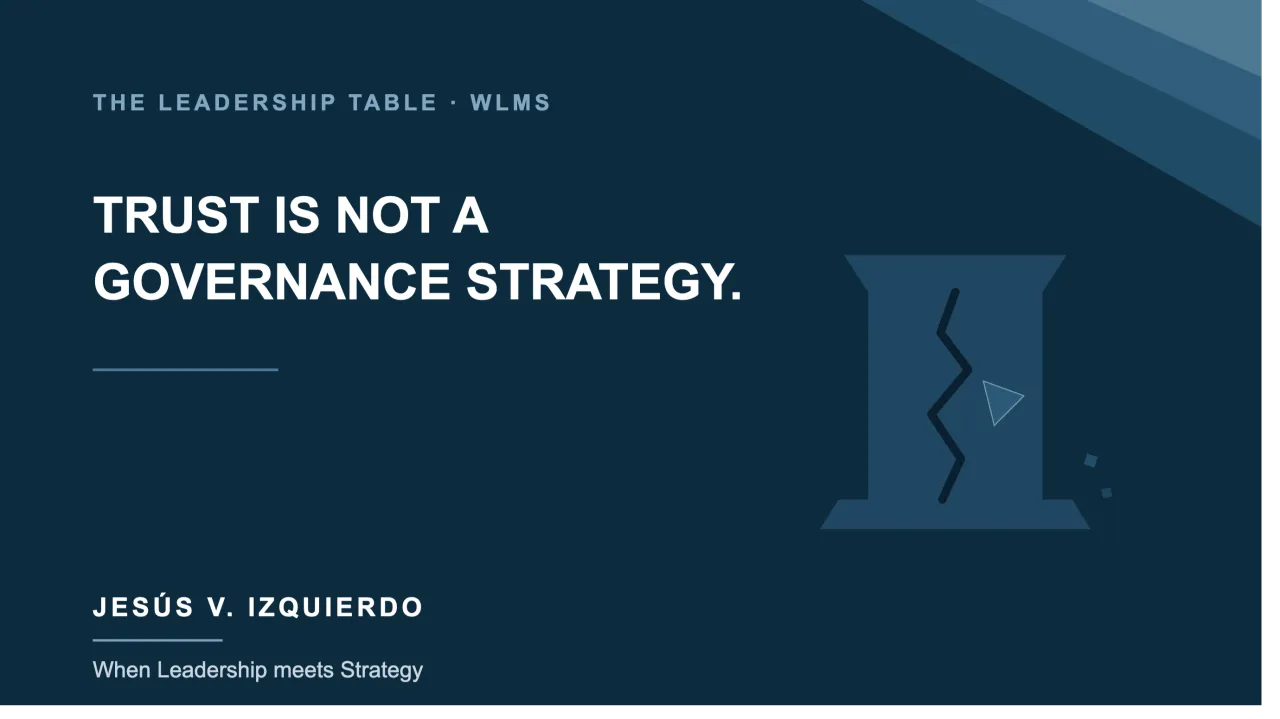
The problem is that trust, as an operating system, does not scale with the thing it is meant to govern. Capital grows. Generations multiply. Interests that were once aligned by default, because everyone needed the business to succeed and nobody had built a life outside it, begin to diverge. A cousin who has never worked a day in the company inherits a vote equal to a sibling who has run it for twenty years. And the system that handled every prior disagreement (call the family, talk it out, trust that everyone wants the same thing) encounters a disagreement it was never designed to hold.
The retroactive instinct
Here is the pattern worth naming plainly: governance, in the overwhelming majority of family enterprises I have observed, is not built. It is retrofitted. It arrives after the crisis it was supposed to prevent, commissioned by the very rupture it should have made impossible.
This should strike anyone paying attention as slightly absurd. We do not wait for the fire to design the exit routes. Yet family capital, often the accumulated work of an entire lifetime and sometimes several, is routinely left to run without a decision architecture until the year something goes badly enough wrong that a board finally gets built to contain the damage.
The honest question is not, then, “does this family have governance?” Almost every family with meaningful assets eventually acquires some version of it. The honest question is: did you build it while trust was still cheap, or are you building it because trust just became expensive?
Those are not the same governance system, even when the documents look identical. One was designed with judgment. The other was designed under duress, frequently by people who are no longer speaking to each other with the goodwill the document presumes they still have.
The steelman… and where it is right
I want to take the opposing case seriously, because it is not a weak one. Over-engineered governance is a genuine failure mode, not a hypothetical. I have watched founders trade the speed that built their company for a committee structure that now requires three sign-offs to approve a decision that, a decade earlier, the founder made alone over lunch. Boards can become theatre. Protocol can become a way of diffusing accountability rather than sharpening it; everyone consulted, no one responsible.
There is a real version of governance that does not protect judgment; it smothers it. A family council that meets quarterly to formally ratify what should have been an obvious call is not governance. It is bureaucracy wearing governance's clothing, and it deserves exactly the skepticism it gets from entrepreneurial founders who resist it instinctively.
So the honest position is not “more governance is always better.” It is narrower than that, and more useful: governance should expand decision quality, not decision volume. If a structure is generating more meetings without generating better-informed, more defensible decisions, it has stopped doing its job regardless of how correctly it was built.
The distinction that matters
What separates the two outcomes is not the sophistication of the documents. It is the moment of construction.
Governance built on trust while relationships are still uncomplicated, while the founder is still willing to cede some authority voluntarily rather than have it extracted from them, while the next generation is still being formed rather than already entrenched in a position, tends to produce genuine decision quality. It clarifies without constraining, because it was designed by people who were not yet defending anything.
Governance built for when trust runs out assembled in the aftermath of a rupture, often at the insistence of lawyers or advisors brought in to manage a crisis rather than prevent one, tends to produce something else: a defensive structure, built to allocate blame and limit future damage, that rarely survives contact with the next disagreement because it was never actually trusted by the people it now governs.
The document can be nearly identical in both cases. The difference is whether it was built as an act of stewardship or as an act of self-protection. Family members can generally tell which one they are holding, even when they cannot articulate why.
Why this is harder than it sounds
None of this is difficult to understand. It is difficult to act on, for a specific reason: building governance while trust is cheap requires someone (usually the founder) to voluntarily give up authority they are not yet being asked to give up. There is no external pressure forcing the decision. The business is working. The family, for now, gets along. Every incentive in the room favors deferring the conversation to a year when it will be more urgent and, not coincidentally, considerably harder.
This is where I think the deeper issue actually lives, not in governance theory, but in what it asks of the person at the center of it. Good governance design has to assume that power, however well-intentioned its current holder, can eventually be misused or simply outlast its usefulness. That is not a cynical premise. It is closer to a humble one. The founders I have seen build the strongest institutions were rarely the most controlling; they were the ones willing to design systems that did not depend entirely on their own continued good judgment, because they understood, correctly, that no one's judgment is a permanent asset.
The question worth carrying into the next board conversation
Not “do we have governance.” Nearly everyone eventually does.
The sharper question: if a serious disagreement arrived at your table tomorrow, not a hypothetical one but the specific one your family has been quietly avoiding, does your current structure resolve it, or does it merely discover, in real time, that no one actually agreed in advance on who gets to decide?
Most families do not know the answer until the day they need it. By then, it is no longer a design question. It is a negotiation.
Next in the newsletter: what actually needs to be decided before it needs to be decided... a working list for the governance conversation most families keep postponing.
If you enjoy strategic thinking without the rigidity of corporate manuals, if you believe leadership needs more agility and fewer coffee-mug clichés, if you’re tired of shallow reflections and enjoy a well-placed, unexpected analogy… then I’ll see you here next week.