The Leadership Table · Growing instead of deciding.
Behind many family-business diversifications lies not a market opportunity but a postponed conversation about who decides once the family no longer fits around a single table. There is a way of resolving family conflict that enjoys excellent press: growth.

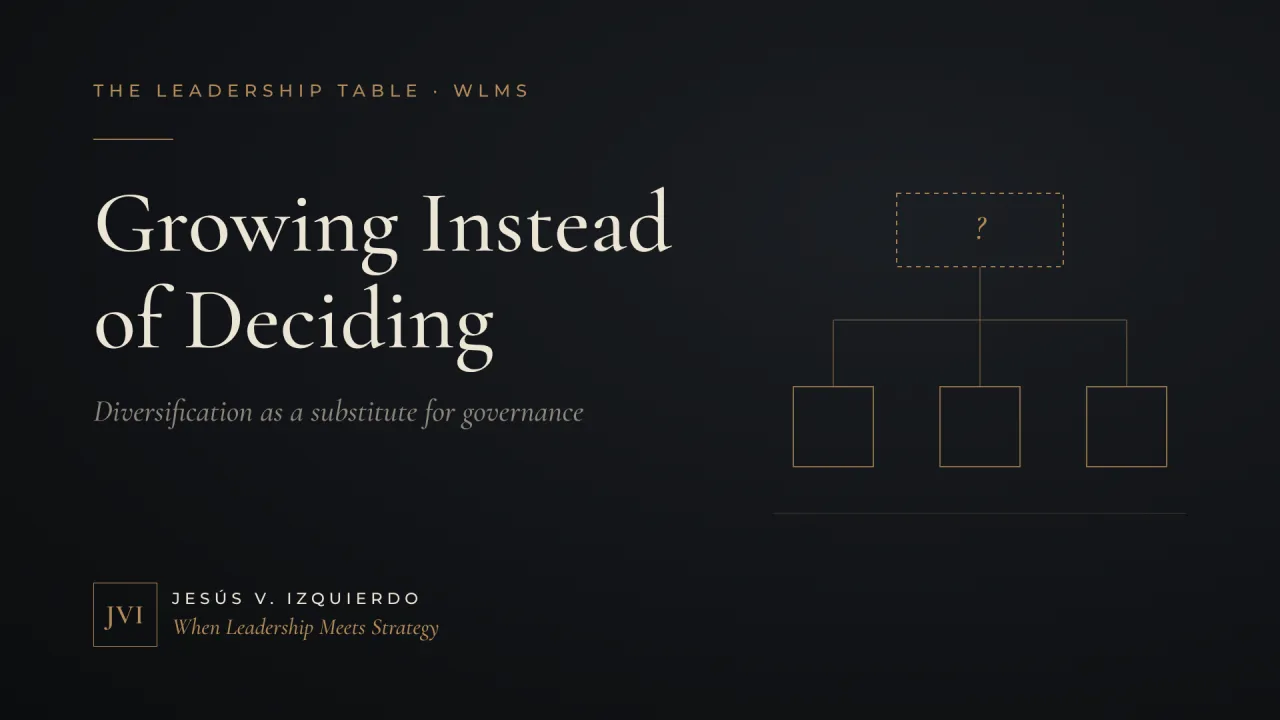
Behind many family-business diversifications lies not a market opportunity but a postponed conversation about who decides once the family no longer fits around a single table.
There is a way of resolving family conflict that enjoys excellent press: growth. When the second generation begins to clash, someone proposes a new line of business, the acquisition of an adjacent company, or a property division to diversify risk. Each branch receives its territory, each sibling a management committee, and the family toasts at Christmas dinner how well it has all been handled. The board calls it diversification. The bank calls it growth. Almost no one calls it what it is: a governance decision taken precisely in order not to take it.
The appeal is obvious. The question of who leads is zero-sum: if one leads, another does not. Diversification turns it, apparently, into a positive-sum question: if the pie grows, nobody has to give up a slice. The founder avoids the most painful decision of his life, choosing between his children, and does so in a way that looks like entrepreneurial ambition and paternal generosity at the same time. Few decisions allow one to look so good at so little apparent cost.
The difficulty lies in the word apparent, and it surfaces in three places.
The first is capital. When a business exists so that someone has something to run, capital stops flowing to where it earns the most and starts flowing to where it keeps the peace. The groups portfolio ends up following a genealogical logic before a strategic one. No analyst will ever put it that way in a report, but any director who has watched investment being allocated across the units of a family group recognizes the pattern: the numbers are debated; the allocation was settled beforehand.
The second is that the conflict does not disappear. It moves up a floor. The question of who runs the company is replaced by harder ones: who allocates capital between the businesses, which one subsidizes which, what happens when one siblings division loses money five years running while the others quietly funds the losses. Answering them requires exactly the governance that diversification was meant to spare the family, now with more complexity, more wealth at stake and more years of accumulated grievance.
Diversification has one undeniable virtue: it defers. Its flaw is that it does not waive the interest.
The third is subtler and probably more corrosive. When each business is identified with a family member, criticizing the business amounts to criticizing the person. Conversations about performance become family conversations, and family conversations obey their own rules, which seldom coincide with the boards. Underperforming units survive, not because anyone believes in them, but because closing them would mean demoting a brother. The group thus accumulates businesses that no one would defend before an investment committee and no one dares question over Sunday lunch.
The opposing view deserves to be taken seriously, because it is strong. Some families recognize in time that their members hold incompatible visions, and they design an orderly separation: distinct holding companies, clear rules, even partial exits from the capital. Such families tend to preserve both their wealth and their relationships better than those that force an impossible cohabitation in the name of unity. Forced unity can do more damage than separation. Those who argue this are right, and any experienced adviser has seen cases in both directions.
So the question is not whether to diversify. It is the order in which decisions are made. There are families that separate by design and families that separate by evasion. The first settled the governance question beforehand: who allocates capital, on what criteria, how a failing business is closed even when it carries the family name, which body decides when two units compete for the same resources. Only then did they conclude that separate businesses were the best answer. The second created the businesses precisely so that those questions would never have to be asked.
From the outside, the two look identical. Same organizational chart, same corporate structure, very probably the same investor presentation. The difference only shows in the first serious crisis, when one business needs capital another has generated, or when someone has to say aloud that a division should be shut down. At that moment, the family that separated by design consults its rules. The family that separated by evasion discovers it never had any, and must now write them at the worst possible moment, without the founder and with everything at stake.
There is a simple test for telling one from the other, and any board can apply it this week: would this business exist if the family had only one heir? If the honest answer is yes, it is a strategic decision that also happens to solve a family problem, which is entirely legitimate. If the answer is no, the board is not looking at an investment but at a peace treaty. And peace treaties need governance, probably more than investments do, because no one sits down to renegotiate them calmly.
The founder who diversifies to avoid choosing believes he is sparing his children a hard verdict. In fact he bequeaths it to them, along with the assets, but without the authority he had to pronounce it. Stewardship of a family enterprise means handing on not only the assets but the capacity to decide about them once the founder is gone. A structure designed so that no one has to decide does exactly the opposite.
The question for the next board meeting is not whether the company should grow in a new direction. It is who would have had to lose an argument if it didnt.
If you enjoy strategic thinking without the rigidity of corporate manuals, if you believe leadership needs more agility and fewer coffee-mug clichés, if you’re tired of shallow reflections and enjoy a well-placed, unexpected analogy… then I’ll see you here next week.