The boomerang of transformation: when change takes you back to the same place
The illusion of changing a lot… without really changing anything Transforming without truly transforming is the corporate version of the hamster on the wheel. Lots of movement, zero progress.

The illusion of changing a lot… without really changing anything
Transforming without truly transforming is the corporate version of the hamster on the wheel. Lots of movement, zero progress.
Every now and then, an organization declares itself “in transformation mode.” Logos are redesigned, consultants are hired with buzzwords like “agile,” “scrum,” or “change agents,” a digital platform is launched, or the word “innovation” is painted on every available wall. But if you scratch a little beneath the fresh paint… the foundations remain exactly the same as always.
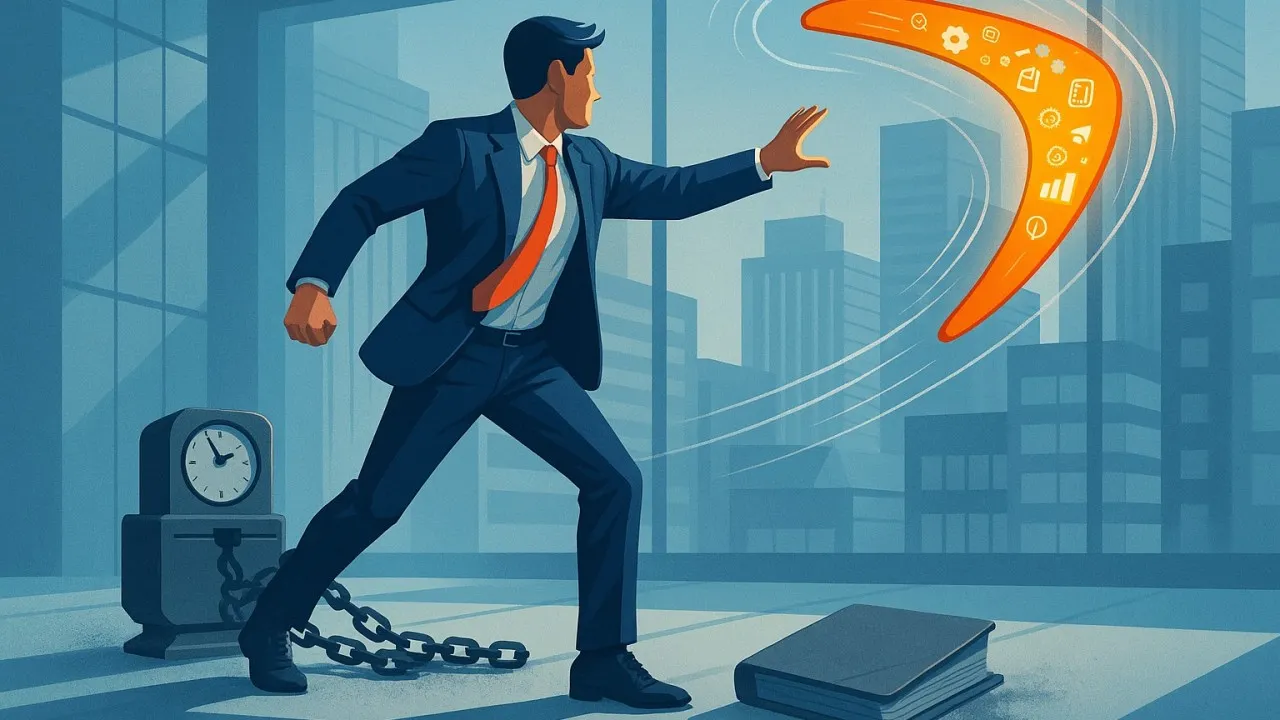
The real problem isn’t starting a change. It’s that, very often, that change is doomed from the outset to spin in circles. A boomerang that flies out with force… but always returns to the starting point. Because a change that only touches the branches, never the roots, does nothing more than stir up leaves.
There are companies that roll out grand digital or cultural transformation campaigns, yet continue operating under the same KPIs, OKRs, and any other acronym that feeds the fantasy of executing real plans and strategies. They keep the same risk-averse leaders and the same incentives that reward control rather than creativity. The paradox is that these efforts, instead of breaking inertia, only reinforce it. They create a change narrative… without anything actually changing.
Ron Johnson, who led JCPenney through two critical years, prompted the iconic retail chain to abandon its traditional coupons and discounts in favor of a “fair pricing” strategy and radical store redesign. The experiment failed to resonate with its core customers, and after a 25% drop in sales, the company had to retrace its steps—returning to promotions, merchandising tactics, and the previous executive leadership model.
Another case of “boomerang transformation” was, ironically, General Electric. In 2015, GE pretty much proclaimed itself a pioneer of the “digital industrial” era with its Predix platform and ambitious plans to become the IoT (Internet of Things) hub for global manufacturing. Four years and billions of dollars invested later, the results fell short of the hype: GE sold off much of its digital assets and returned to its traditional industrial focus, implicitly acknowledging that the change had been more cosmetic than structural.
The outcome of these boomerang transformations: organizational fatigue, team skepticism, and a transformation that becomes its own obstacle. Cosmetic change is more dangerous than open resistance because it creates the illusion that we’ve already done what was necessary.
When change becomes “performance” (a show…) rather than real practice and delivery, organizations stall in style. There are innovation rituals, disruption committees, design-thinking sessions… yet they continue to reward those who never make mistakes—because they take no risks—and punish those who dare to try something new.
Transforming without discomfort is an executive fantasy. Real change hurts, creates tension, and forces a reevaluation of who makes decisions, how results are measured, and what must die so that something new can emerge.
The gap between rhetoric and reality not only erodes internal culture—it also neutralizes any genuine attempt at evolution.
An organization can talk about a “collaborative culture” while its leaders operate under hierarchical mindsets. It can fill its social feeds with human-interest storytelling while, in practice, silencing any real voice in key decisions.
And when talk finds no anchor in action, change becomes a mockery. No matter how many change ambassadors you appoint—if the system itself isn’t redesigned, the boomerang will end up on your forehead.
Transforming isn’t about iterating processes or digitalizing operations. It’s about challenging what was once taken for granted.
Real change doesn’t start with an app. It begins when an organization dares to ask itself uncomfortable questions:
What part of our culture must die so that something new can be born? Are we truly rewarding initiative, or are we secretly punishing it? Who has permission to propose, and who merely executes?
Answering those questions can hurt. But what hurts even more is constructing a grand transformation narrative… only to discover, over time, that we’re exactly where we started.
This is not a call to change for the sake of change. It’s a call for change that goes beyond an elegant narrative.
Because, at heart, every superficial transformation is a squandered opportunity. It’s not that we lack technology, consultants, or good intentions. What we lack is the courage to dismantle what no longer serves us—even if it got us here.
And one final recommendation, because I’ve seen it many times in different organization, beware of the “Zoolander effect,” invoking Ben Stiller’s comedy: don’t become a corporate fashion victim.
If you enjoy strategic thinking without the rigidity of corporate manuals, if you believe leadership needs more agility and fewer coffee-mug clichés, if you’re tired of shallow reflections and enjoy a well-placed, unexpected analogy… then I’ll see you here next week.