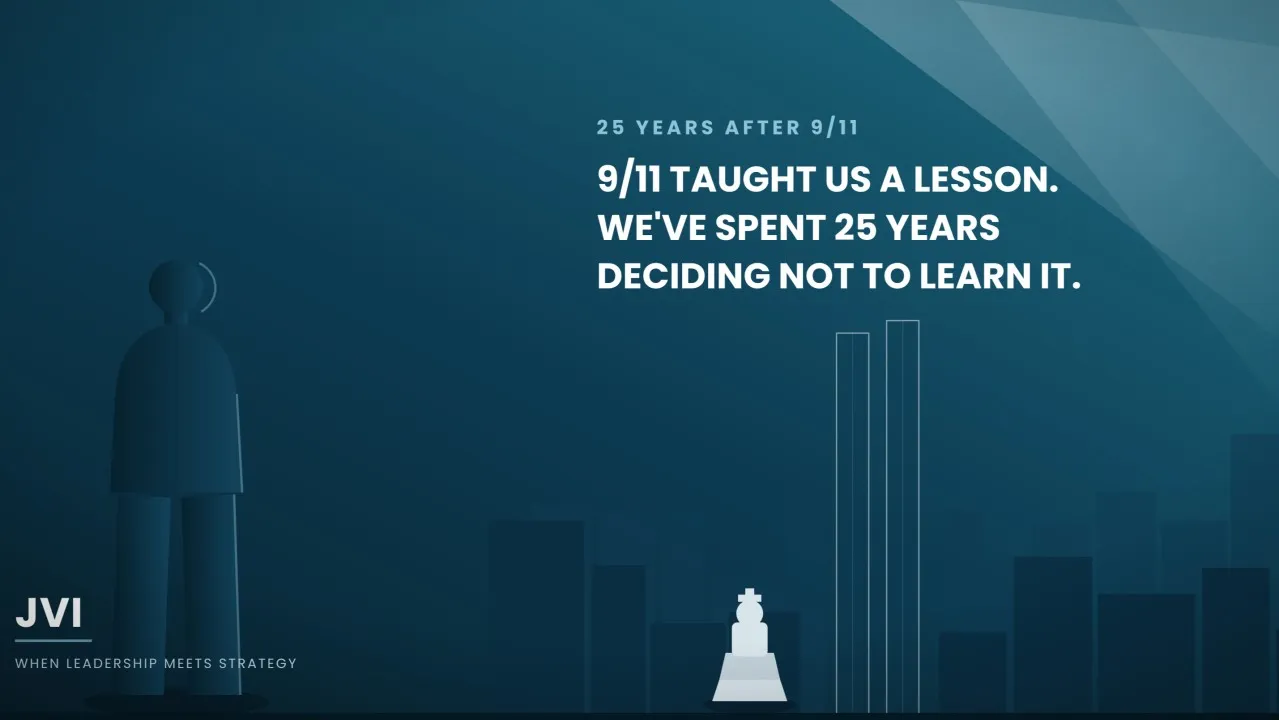
9/11 taught us a lesson. We've spent twenty-five years deciding not to learn it.
Boardrooms rarely put civilizational confidence on the agenda. Twenty-five years after 9/11, they should.

Boardrooms rarely put civilizational confidence on the agenda. Twenty-five years after 9/11, they should.
Twenty-five years ago in early September, I was in New York City that Labor Day weekend. Days later, on September 11 itself, I was in Washington, D.C., where I lived. I remember a very particular silence that morning, not quite fear. It was the sound of certainties breaking.
Everyone who lived through that week believes they understand 9/11. Twenty-five years of anniversaries have flattened it into a familiar shape: an attack, a war on terror, a different airport, a decade of conflict in Afghanistan and Iraq, a slow withdrawal. That is the story told at every anniversary.
It is not the story that should matter most to the people who will sit in boardrooms this decade.
The West did not lose the war it thought it was fighting. Al-Qaeda's core leadership was destroyed. ISIS lost its caliphate. There has been no second mass-casualty attack on U.S. soil remotely resembling the original. On the narrow military and counterterrorism ledger, the West essentially won.
And yet, twenty-five years later, something strange is true: the civilization that won that war looks weaker than the one that entered it.
Here is the uncomfortable proposition: 9/11 was never really a test of Western military capacity. It was the opening move in a longer test of Western conviction and that second test, the one nobody put on a calendar, is the one we are losing.
Call it the Conviction Deficit: a civilization can lose a war of arms and recover within a generation. It rarely recovers from a war of conviction it does not even recognize it is fighting.
Consider the ledger honestly.
Demographically, Europe is erasing itself by its own numbers. Fertility across the EU sits around 1.4 children per woman, nowhere near the 2.1 needed to replace a population, and Eurostat's own projections show the EU's population beginning to shrink this very year, a continent that represented one in ten people on earth in 1974, heading toward one in twenty-five by century's end. A civilization stops authoring its own future the moment it stops having children to inherit it.
Institutionally, the confidence that once let Western democracies act with speed and conviction has been replaced by a permanent negotiation with themselves; process substituting for judgment, caution substituting for courage, consensus substituting for decision. Boards behave the same way. So do governments.
Strategically, energy, critical minerals, semiconductors, and increasingly artificial intelligence infrastructure now run through supply chains partly controlled by rivals who do not share the West's assumptions about rules, sovereignty or restraint. A dependency accepted in the name of efficiency and rarely discussed in the language of vulnerability.
The strongest objection deserves a hearing, not dismissal. The West has been resilient in ways few predicted in 2001: economically dominant, ahead on the technological frontier that matters most, its alliance structure reinvigorated rather than dissolved by the war in Ukraine. Samuel Huntington's warning that civilizational identity, not ideology, would define this century's conflicts has proven more prescient than most 1990s international-relations theory and the West has, in fact, held civilizational ground militarily, on NATO's eastern flank as much as in Afghanistan.
That is a fair point. It is also incomplete. Winning battles while losing the argument for why they are worth winning is not a paradox unique to the West, it is the oldest pattern in the decline of great civilizations. Rome did not fall to a superior army. It fell to an army it had stopped wanting to join.
This is where geopolitics stops being an abstraction and becomes a leadership question. Every civilization that has ever mattered has eventually faced the same test, and it is never primarily military: does this generation still believe its way of life is worth the sacrifice required to defend it? Rome, Byzantium, and the fading empires before them all answered no long before any enemy forced the question. The strategic threats of 2026: a revisionist Russia, a patient and ascendant China, radicalized non-state actors, a fractured information ecosystem manufacturing doubt at industrial scale. All these threats are dangerous mainly because they are arriving at the exact moment the West has quietly stopped answering that question with conviction.
C. S. Lewis saw this coming with unusual clarity, decades before it was fashionable to say: a civilization that stops forming people of settled conviction and inner discipline — what he memorably called "men without chests" — should not be surprised when it can no longer produce the courage its own survival requires. Thomas Sowell would put the same insight in economic language: societies get the incentives, and eventually the character, they choose to reward. We have spent thirty years rewarding comfort, credentialism and moral neutrality, and calling the result progress.
Boards and leadership teams should stop treating "geopolitics" as a slide about tariffs and shipping lanes. There are, functionally, three fronts that matter now: the demographic front (who will build, defend and pay for the next fifty years), the dependency front (whose infrastructure and critical inputs your business quietly depends on), and the conviction front (whether your own institution still has the discipline to make hard, unpopular, correct decisions before a crisis forces them).
Most companies have a strategy for the first two. Almost none have one for the third and it is the one that determines whether the other two get addressed in time.
This is not a call for nostalgia or triumphalism. The West's record includes real failures, real hypocrisies, real cruelties, and pretending otherwise would insult the intelligence of anyone qualified to sit on a board. But a civilization is not judged only by whether it has ever failed its own principles. It is judged by whether enough of its leaders still believe those principles are worth defending, correcting and passing on. Stewardship, not self-congratulation, is the Christian instinct underneath that distinction; the conviction that what we inherited was never fully ours, and that our only real obligation is to leave it stronger than we found it.
Twenty-five years ago, an empty sky over Washington told an entire generation that the world had changed. The harder question, a quarter century later, is not whether the world changed.
It is whether we did.
If you enjoy strategic thinking without the rigidity of corporate manuals, if you believe leadership needs more agility and fewer coffee-mug clichés, if you’re tired of shallow reflections and enjoy a well-placed, unexpected analogy… then I’ll see you here next week.